The pallet industry is valued at $5.86 billion. This is the story of one of those companies who, in the last 40 years, has become a leader in the industry: PRS Group Inc.
The Beginnings
In 1965, Lonnie Williams was 24, working at his father’s sawmill in Scottville, Illinois, cutting grade lumber for furniture and construction. Lonnie also delivered wood to companies that used pallets.
Working for his dad, Cecil Williams, was consistent work, but Lonnie had the heart of an entrepreneur, even though he might not have known it yet.
In these early years as Lonnie made deliveries to these companies and worked at the sawmill, an idea started coming together. The family sawmill scrapped its lower grade lumber, and meanwhile large companies were either buying pallets or building them in-house.
Soon he started cutting the low-grade lumber into different sizes and nailed the pallets together by hand. “He loved tinkering with mechanics and was always thinking of better ways to do things” his son, Jeff remembers. “So, he made pallets and delivered them. He could see there was promise in it.”
Lonnie left his father’s sawmill and started his own pallet company, delivering pallets to facilities.
One day, he delivered to a glass jar manufacturing company in Alton, Illinois. While waiting to unload near the guard shack, he noticed that used pallets were being tossed into a dumpster. “What are they doing?” he asked the guard. “The pallets must have a broken board,” the guard replied. “They just throw them away and buy new ones.”
Lonnie made a deal to have the broken pallets set aside. He wanted to repair them and sell them back at a fraction of the cost. “It wasn’t known as recycling, yet,” his son, Jeff, says. “He was a bit of an opportunist, an entrepreneur in the making.” He was a pioneer in pallet repair, and pallet recycling was being born.
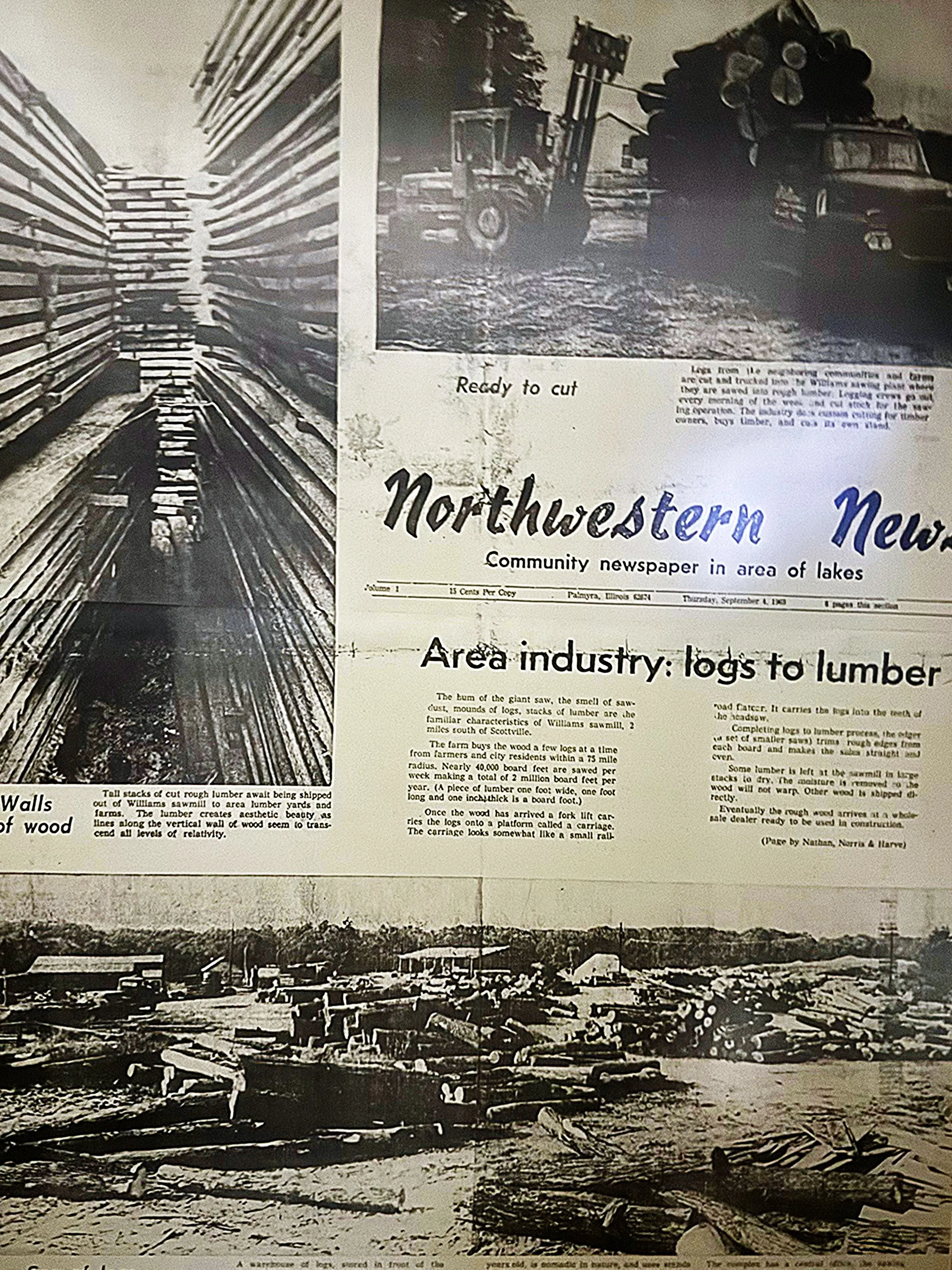 A newspaper article about the Williams' family sawmill business in Scottsville, IL. The article features Cecil Williams, Cecil Williams, Jr., and Lonnie Williams.
From Pallet Building to Pallet Repair
That encounter lit a new fire in Lonnie, and he began a whole new business: pallet repair. “But there was no machinery at the time to do any of the tasks, to take a pallet apart or trim a board. It was literally crowbars and hammers,” Jeff says.
Lonnie recognized that if one company could benefit from repaired pallets, other companies could too. But he kept his attention on raising his family and running several wood-related businesses, reserving evenings for designing and experimenting with pallet repair methods and possible machine solutions to the tasks. His skills, experience and passion were coming together.
Lonnie became an inventor, applying for patents for the machines he built. “He was very proud, and protective of the ideas and inventions he came up with”, Jeff remembers.
The first machine was a three-head, rotary dismantler. When a competitor tried to copy it, Lonnie fought for – and won – a patent in 1982. “That was a point of pride for him, for sure,” Jeff says. Lonnie later invented pallet plates to repair pallets and a stringer splicer and plating machine.
Industry colleagues would visit from St. Louis and Chicago and ask Lonnie to build his pallet repair machines for their companies.
Pallet Repair Systems, Inc.
That patent may have given Lonnie the confidence to start Pallet Repair Systems (PRS) in February 1989. In the late 80’s Lonnie and his son, Greg, continued to experiment and develop pallet machines while running the family pallet company. In 1988, several machine designs that applied metal connector plates to pallets and 2”x 4”s showed commercial promise. In early 1989, PRS was incorporated.
Later that year, Lonnie’s son, Jeff, graduated from college with a marketing and small business entrepreneurship degree. He worked briefly for a large company in Chicago. “I hated it and quit after two months,” Jeff recalls.
Jeff wanted to stay in the Windy City, but Lonnie needed sales and marketing and wanted him to join PRS. So, he made his son a deal: rent money in exchange for Jeff marketing the patented pallet repair machines. “There are a lot of pallet companies in Chicago, so I knocked on doors, and it worked. We were like, ‘Now what do we do?' ”
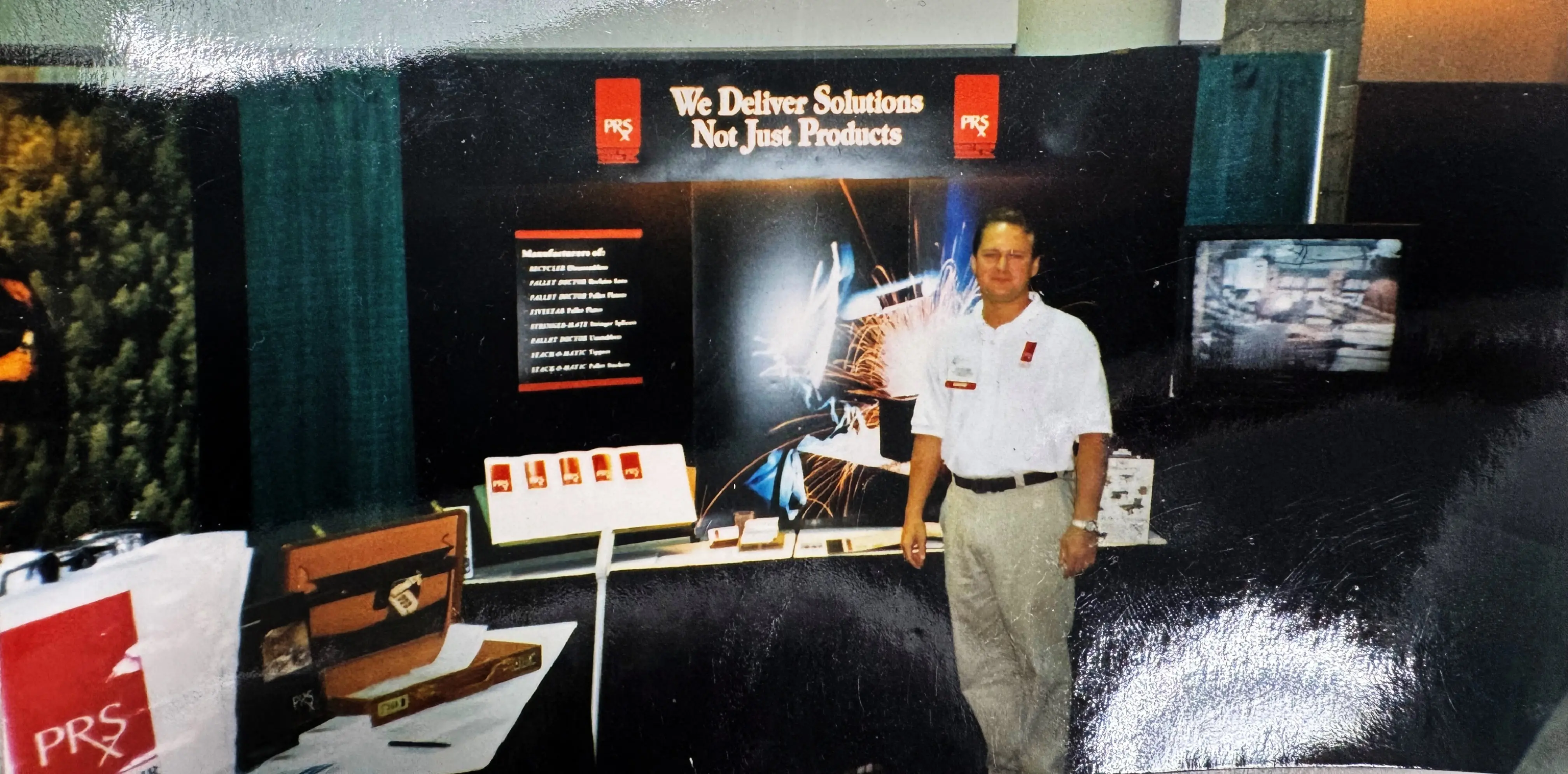 Jeff Williams, the third generation of pallet industry entrpreneurs, joined the family business in 1989. This photo is circa 1992.
Lonnie had a friend who was a retired engineer and another who owned a steel fabrication shop. Lonnie and the engineer turned cocktail-napkin sketches into blueprints. The fabrication shop turned those blueprints into commercial machines.
Jeff got to work marketing the business by attending trade shows, joining NWPCA, and making a name for himself and PRS in the industry, which grew exponentially in the 1990s.
With Jeff on board, PRS Group solidfied its footprint on the pallet industry. They leased a 5,000 square foot warehouse in Springfield in 1991, finally convincing Jeff to move back to Springfield and join PRS.
The Springfield facility was outgrown, and the company relocated to Jacksonville in 1999.
“In the first 10 years, we had a handful of guys in the shop making pallet plates and building three or four machines. We hired another salesman and an engineer, and then more production staff” Jeff recalls. PRS Group was growing fast.
The company building pallets, now run by Lonnie’s son Greg, shuttered in 1994 after more than three decades. Now, the family could fully devote itself to PRS Group. Lonnie’s wife, Carolyn, was the first bookkeeper. Greg became the plant manager, and Jeff stayed out in front as the face of PRS and soon became president of the company.
The Next Generation of PRS
“PRS Group was Dad’s passion,” Jeff says. “For years after he retired, he would come to PRS to take Greg and me to lunch, but it was really so he could walk through the plant and see what was going on. I miss that now.”
“The business was his romance – it’s why he got up every morning,” Jeff continues. “He would call me at 10 pm at night to talk business.”
Although not trained in business, Lonnie’s hard work and determination led to the success of several businesses and the start of a family legacy. “He had a lot of doubters – he wanted to prove them wrong,” Jeff says. And he did.
Lonnie passed away in 2024. Jeff recalls of his dad, “He was a brilliant guy and loved being a capitalist.”
Lonnie’s last big adventure with PRS was attending a trade show in Bordeau, France, with Jeff, where they began their connection with CAPE, one of the world’s leading suppliers of automated pallet-nailing and pallet-manufacturing equipment. “I remember the family was against the idea of partnering with CAPE,” Jeff recalls.
Wanting to see CAPE machines in action, Jeff and Lonnie traveled to Switzerland. “Dad had his head inside the machine and said, ‘These machines are no joke, Jeff; you’re on to something here.’” They shook hands with CAPE ownership and started a new partnership. “It was a bold move but is of the best things we have done, expanding into pallet manufacturing and nailing equipment.”
That bold move aligned with Jeff’s vision as PRS’s leader. “My goal has been to expand the business, including international sales,” Jeff says. “By partnering with CAPE and their network of dealers around the world, we’ve shown that we can compete with bigger companies, bring these machines to the United States, install them, support them --- and people are going to love them. It’s worked very well.” From Australia, New Zealand to Europe, Central and South America, PRS Group continues to expand its influence.
Legacy & Growth
At the 42,000 square foot facility in Jacksonville, the company has expanded to more than 30 employees, including designers and manufacturers. A point of pride at PRS is the tenure of many employees. Ten, 15, 20, and 25 years at PRS Group is not uncommon. Lonnie’s son, Greg, is engineer and head of R&D, solving the design and manufacturing challenges and enjoying the rewards of seeing a vision become a reality.
As CEO, Jeff is very active in the pallet industry and has served on the board of directors for NWPCA, a pallet recycling association, and the Pallet Foundation. “For me, it’s about feeling and understanding the marketplace and where the pallet industry is headed. It is also rewarding to contribute and give back to the industry which has meant so much to our companies and our families”
In 2008, the housing/banking crisis led to plummeting sales of new equipment. Jeff expanded the business model to include used machinery, which continues as a strong part of PRS.
The labor crisis during the COVID pandemic in 2020 also was a milestone for PRS’s business plan.
“Everything ships on a pallet,” Jeff notes. Pallets were in high demand during COVID, but labor was limited. “The pallet industry was deemed essential, but nobody wanted to work since they were paid to stay home.” Automation equipment sales skyrocketed.
That trend has continued due to inflation, high labor costs, and challenge of hiring quality laborers. PRS’s business model can meet these demands. “Our equipment displaces the reliance on labor and provides capacity to have higher production throughput.”
Jeff has continuously steered PRS toward evolving technologies, such as robotic sortation systems that can apply to new industries and relieve the labor challenges. “I want to have a larger company with a bigger footprint and leave a legacy,” Jeff says. He has his eye on distribution centers that are sorting and doing light repair of pallets. This saves money and eliminates waste doing pallet repair on site. PRS has also added preventive maintenance to its service list and continues to invent new products.
With vision and innovations, Jeff note that the staff make it possible.
Closing in on its 40th year, PRS Group is global leader in the pallet sortation, repair, and recycling machinery market, yet is still rooted in family values, where a handshake still means something, where entrepreneurship can pivot and thrive in an uncertain economy, where the third generation of inventors can continue the family legacy.
As long as everything ships on a pallet the possibilities are endless.